Your Brand Name Used to Be a Guaranteed Click. Not Anymore.
AI Overviews hit navigational search hardest, turning guaranteed branded clicks into a slow comparison step. Your branded demand isn't yours to own.

For almost twenty years, typing a company’s name into Google would quickly take users straight to the right website. Google acted as a gateway, not the final stop.
Now, this process is slowing down and affecting users that marketers once thought were already won.
A recent analysis of approximately 846,000 U.S. Google sessions by ClickStream Solutions, using anonymised Surfer SEO data, examined user behaviour on results pages before any clicks. It tracked cursor movement, scroll direction, and time spent. While many will note that AI Overviews slow searchers, the more significant insight is which users are most affected. This should concern anyone who considers branded traffic a guaranteed asset.
The channel everyone assumed was bulletproof.
Navigational search has always been the most reliable part of SEO. People who search for your brand name usually go straight to your site without needing extra convincing. They’ve already decided, they’re looking for you specifically.
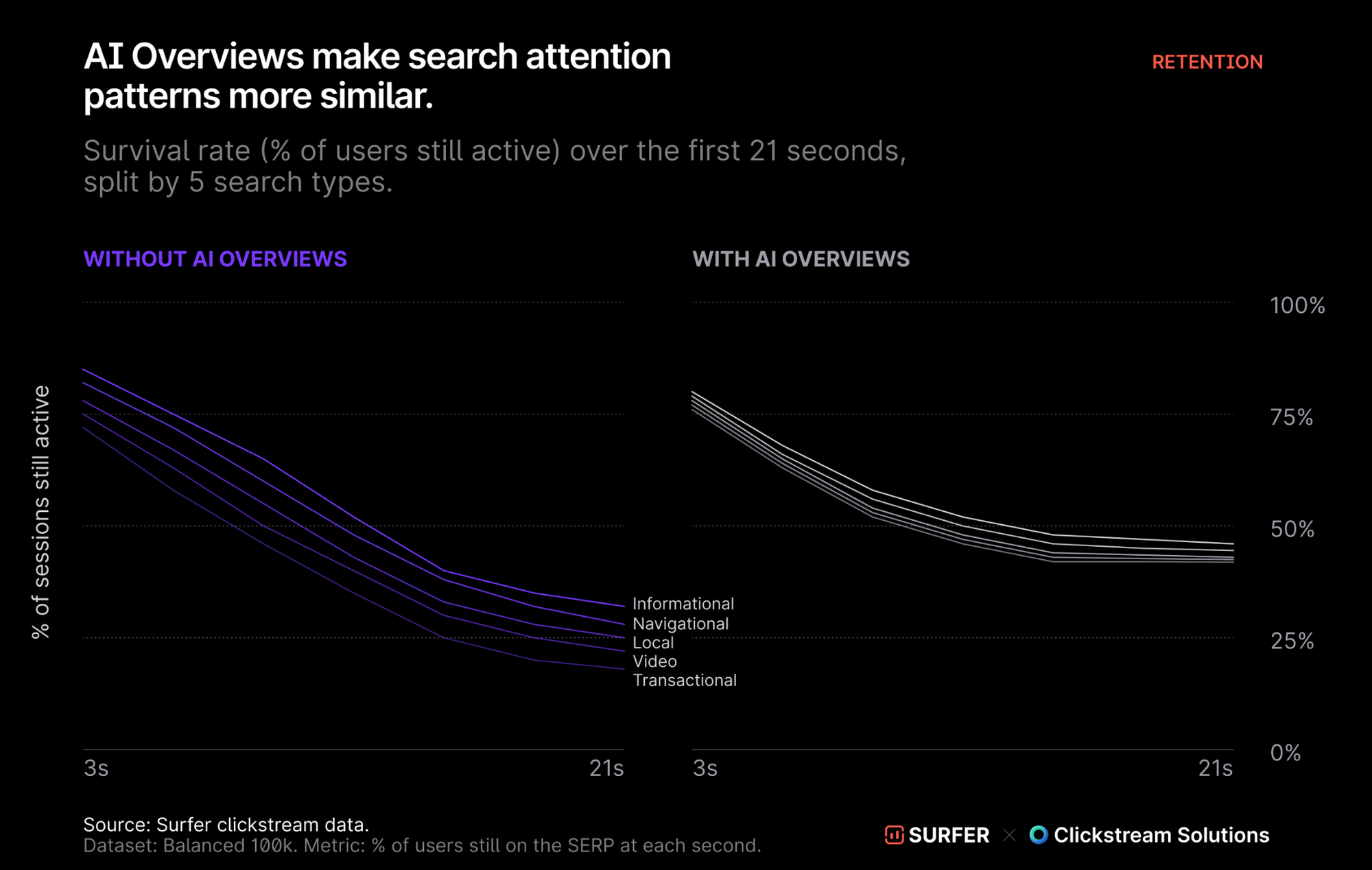
But the data challenges that belief. Without an AI Overview, only about 12% of navigational searchers stayed on the results page after 21 seconds. With an AI Overview, that number jumps to 46%. People who used to click through right away now spend almost 4 times as long on Google.
Cursor movement backs this up. The study found that navigational searchers usually scan in a focused way, with a cursor spread of about 8%. When an AI Overview appears, the spread grows to around 27.5%. Even users who know exactly what they want start looking around more.
This change affects people who search for your brand directly, not just casual browsers. Now, even these users are encouraged to explore other options before they reach your site.
This is a comparison, not confusion.
This behaviour shows users are comparing, not getting confused or lost. The scroll data supports this.
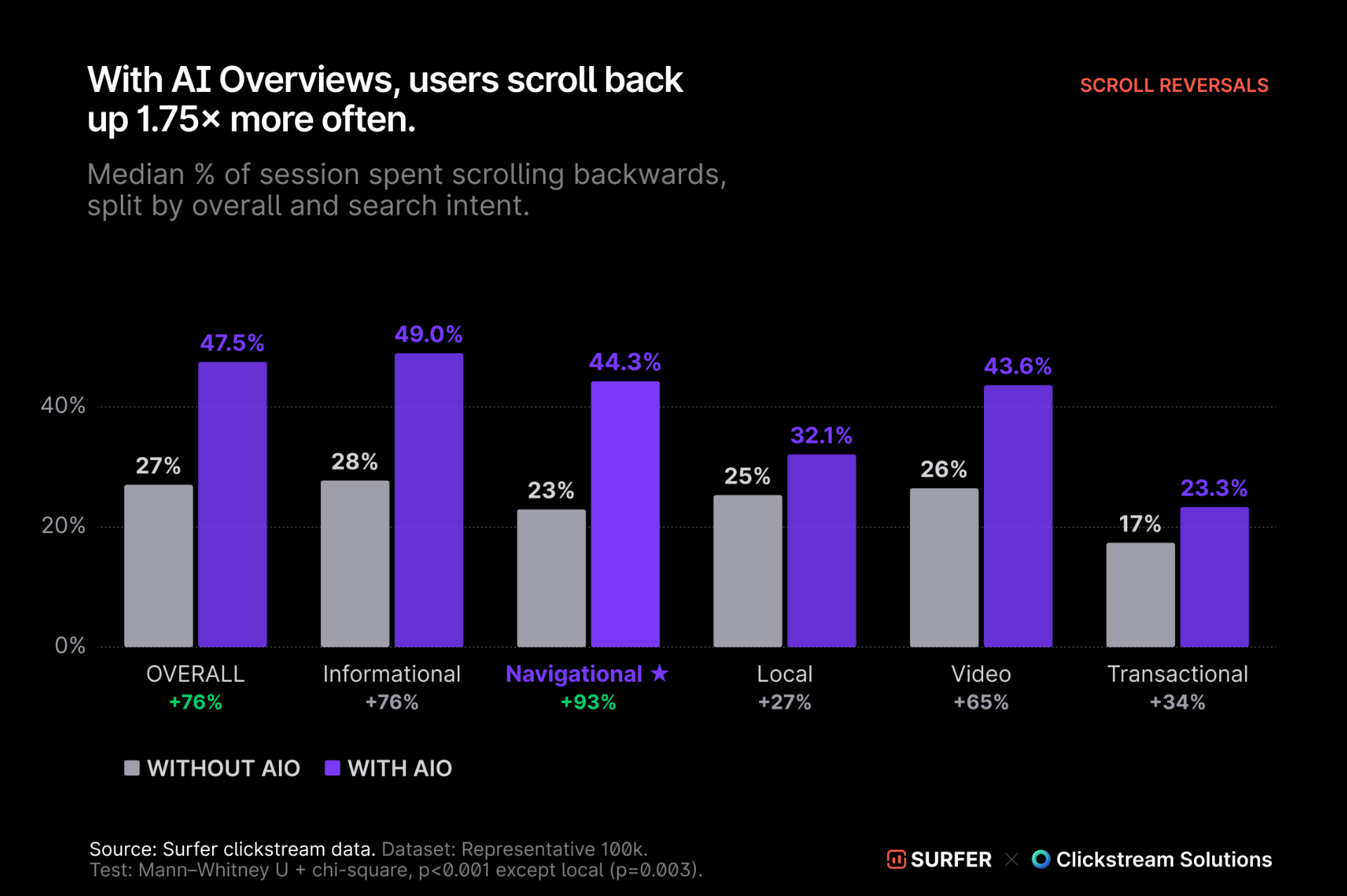
ClickStream also tracked whether users scrolled back up after scrolling down. With AI Overviews, this happened more often, rising from about 51% to 59%. Even more telling, users on AI Overview pages spent about 47.5% of their scrolling time going back up through content they’d already seen, compared to 27% without an Overview.
Navigational searchers changed the most, with back-scrolling jumping from about 23% to 44%. People are re-reading, double-checking, and weighing their options right on the search results page, before they visit any brand’s site. View does more than delay clicks; it introduces a comparison phase into a previously straightforward journey. Google has added a decision point to queries that were once direct.
Google is making this change on purpose.
Another pattern stands out: without AI Overviews, the five types of search intent in the study (informational, local, navigational, transactional, video) had different engagement levels at 21 seconds, from 12% to 32%. With AI Overviews, these differences shrink, and all types cluster between 42% and 49% engagement.
This shows Google is intentionally making the user experience more uniform. Now, the reason for a search matters less; how long people stay depends more on the page itself.
For Google, keeping users’ attention is key to its business. Getting everyone to slow down and compare options is a deliberate part of their strategy.
The underlying shift
It’s important to look at the bigger picture. Optimising snippets helps, but it’s not enough on its own.
The role of search is evolving. For twenty years, it served primarily as a navigation layer between a query and a website, where decisions were made. Now, the search results page is increasingly taking on the functions of reading, comparing, and reconsidering, tasks that previously occurred on individual websites.
Navigational search is an early warning sign. If Google can slow down or redirect people searching for your brand name, then you don’t fully own any part of your traffic. Branded demand isn’t guaranteed anymore; you have to earn it within Google’s space.
It’s still important to improve your meta description, since vague previews don’t work well when people are comparing options. But the main change is strategic: treat your branded search results page as a competitive space where people make decisions, often before they visit any site.
Successful brands will realise that the customer journey now often starts and sometimes ends on a page they don’t control.