Cricket's biggest fans now search before they scroll. AI is rerouting where that begins.
Google's cricket playbook says spend more on YouTube. The more interesting story is what AI search is doing to how fans find anything in the first place.

With IPL 2026 wrapping up in Ahmedabad this weekend, Indian cricket fans are searching online more than at any other time this year. Google’s new sports marketing playbook highlights why this matters. The main idea is clear: fandom now goes beyond watching live matches. But the playbook doesn’t fully address the key question for anyone interested in AI - what’s happening to all that searching?
Let’s look at the main point because it’s true. Cricket fandom in India now stretches across the entire year. Fans spend more time preparing for games, analysing them, and discussing them afterwards than watching live. According to Google, non-live content now makes up about 20% more of fans’ time than the match itself. The live game, once the focus of the industry, is now a small part of a fan’s day.
Google’s advice makes sense: don’t focus only on live broadcast airtime. Instead, invest across the season on platforms like YouTube and Search, where fans spend their time. But there’s an important detail in the playbook, a brief mention of AI Mode in Search, that deserves more attention. The way fans look for information, debate, and question decisions is exactly what answer engines are designed to handle. That’s the idea I want to explore.
Four key fan behaviours, and two of them are quietly shifting.
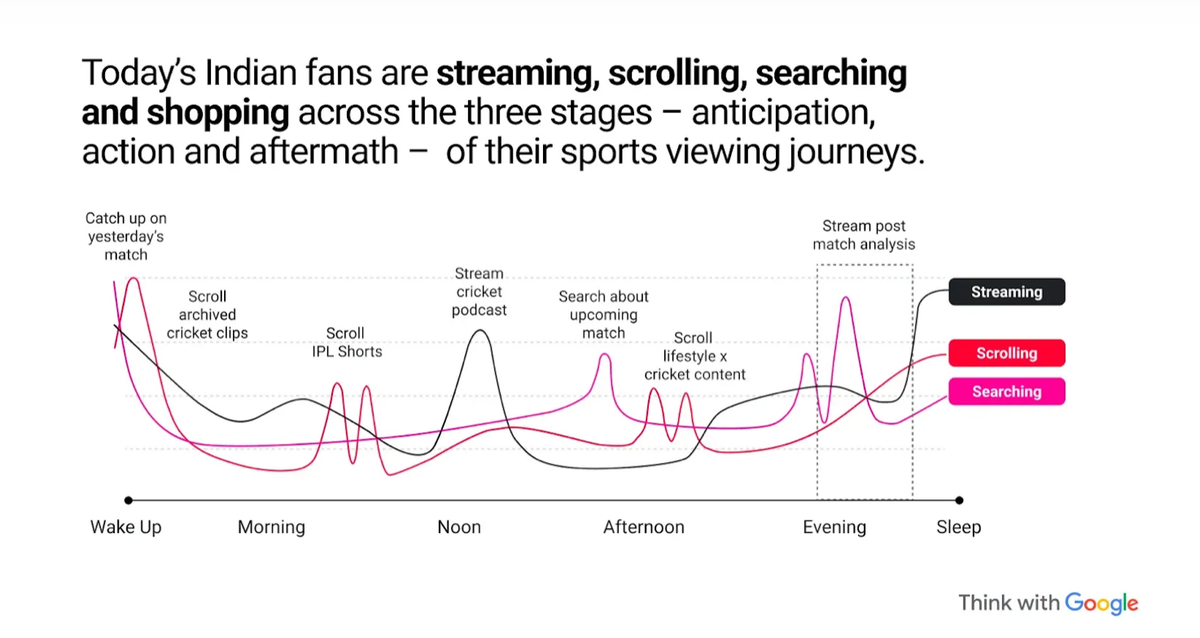
Google breaks down fan activity into a cycle: stream, scroll, search, and shop. Fans go through three phases: getting excited before the game, multitasking during the match (with nine out of ten viewers using a second screen), and reliving highlights for days after. Surprisingly, 42% of fans continue to engage several times a week even after the season ends.
Streaming and scrolling are video-based habits, mostly happening on YouTube, and they’re huge. Searching and shopping are different; they’re driven by intent, and that’s where AI is making big changes.
Consider where the searching piles up. Capgemini found that nearly 70% of fans look up player stats and match data before a ball is bowled. Nobody does that idly. That's somebody asking a real question and wanting a real answer. What's Bumrah's economy this season? Who steps in for the injured opener? Why is this surface turning square so early?
Last year, that question went into a search box, returned 10 links, and sent the fan to a stats site or a preview video. Now, more and more, it just hands back the answer, stitched together at the top of the page. Numbers, context, a bit of analysis, all without the fan clicking through. The visits that used to land on publishers or creators increasingly don't land anywhere.
Google says it plainly that AI Mode gives fans the deeper insight that powers their daily back-and-forth. Set that next to the 70% figure, and the implication is hard to miss. The pre-match digging that once spread across dozens of sites is now resolved inside the engine before the fan ever leaves it.
The Crictuber is an answer engine with a personality.
My favourite bit of the playbook is the part on "Crictubers," the cricket YouTubers who long ago stopped doing dry recaps and turned into something closer to emotional mirrors for their viewers. Gaurav Kapur's Oaktree Sports channel, with 2.1 million subscribers, is the obvious example. He reacts to a moment with the precise tone and technical depth his audience wanted, confirming what they were already feeling.
It’s worth thinking about, because this is similar to what an answer engine does. When a fan sees a questionable lbw and feels upset, they look for someone to confirm their feelings and explain why. A Crictuber does this with warmth and humour. An AI answer delivers it instantly, without waiting for a video upload.
They aren't enemies exactly. They're two doors into the same room, both serving the itch to understand and be validated about what just happened. The creator wins on community and the joy of a shared reaction. The engine wins on raw speed. Fans chasing a feeling will keep going to the human. Fans chasing a fact are increasingly served before the human shows up.
For now, both approaches are thriving. Fans still watch recaps and also search for information. But AI is transforming the search experience, and wherever search leads, discovery and advertising dollars will follow.
About those numbers
The playbook is generous with data, and the broad direction rings true. YouTube cricket views in India jumped to 190 billion, up from 50 billion in mid-2024. Fans rate YouTube creators as the most trusted voices for product picks. These are Google's own figures, which are worth noting as you would for any platform promoting its own reach. The underlying story, that video sports viewing is massive and lives mostly on YouTube, is almost certainly real. The discovery question is sitting underneath. They count how much gets watched. They're a lot quieter on how fans arrive at what they watch, and whether that arrival step is starting to happen inside an AI answer before any video loads. No knock on the data. It's just the next chapter, and it's the chapter that matters most if you're building for where attention is going rather than where it currently parks.
What brands should actually do with this
The strategic advice survives intact. Pace the spend across the season instead of blowing it on live airtime. Back creators, because trust beats interruption. Use longer formats to tell a story rather than just flash a logo. No argument there.
I'd add two things.
One, start treating search visibility as a fandom play, not an IT chore. If 70% of fans research before the match, being present in those answers counts as much as being present in the highlights. Once the engine synthesises rather than lists, the goal stops being "do we rank" and becomes "does the generated answer mention us at all." Different game. The brands figuring it out now will own the pre-match window later.
Two, keep an eye on the discovery layer, not just the consumption one. YouTube reach tells you how many people watched, but says nothing about how they found it or whether next year's version of that journey even passes through a video. Build only for today's front door, and you're building on the ground. AI search is slowly pulling out from under you.
Google's marathon framing is right. The fandom runs all year now, always on, far bigger than the ninety minutes of play. The real test comes the morning after the final, when the trophy's lifted and the spectacle goes dark. The fans don't go dark. They keep searching, keep squabbling, keep reliving it. The only question left for 2026 is which surface provides the answer, and I'd be watching the answer engine.
Featured Image: Think with Google