Answer Engine Optimisation: The Complete Guide for Indian Marketers
Answer Engine Optimisation (AEO) is changing how Indian brands get discovered online. This complete guide covers what AEO is, how it works, and the exact strategies Indian marketers need to get cited by Google AI Overviews, Perplexity, and ChatGPT.


69% of Google searches now end without a click.
That means most people get their answer directly on the search results page and never visit your website, see your ads, or posts. This is the new reality. The need to adapt is immediate. Delay now, and you risk disappearing. Transitioning from traditional strategies, Answer Engine Optimisation (AEO) empowers your brand to become the answer, not just a result.
What Is AEO? A Plain-English Definition
Answer Engine Optimisation is the practice of structuring your content so AI-powered tools and search engines quote it directly. Think of it this way. When someone asks Google Assistant, "What is the GST rate on restaurant food?" - an AI reads thousands of pages and picks one to quote. AEO is how you become that page. You are not optimising to rank. You are optimising to be cited. The rise of tools like Google's AI Overviews, Perplexity, ChatGPT, and Bing Copilot has changed the game. These tools pull answers from the web. They summarise. They synthesise. If your content is not structured clearly, they skip you entirely.AEO puts your brand in the machine's mouth.
Let’s move from defining AEO to understanding how it differs from other approaches.
You have probably heard of SEO (Search Engine Optimisation). You may have also heard of GEO (Generative Engine Optimisation). Here is how all three compare.
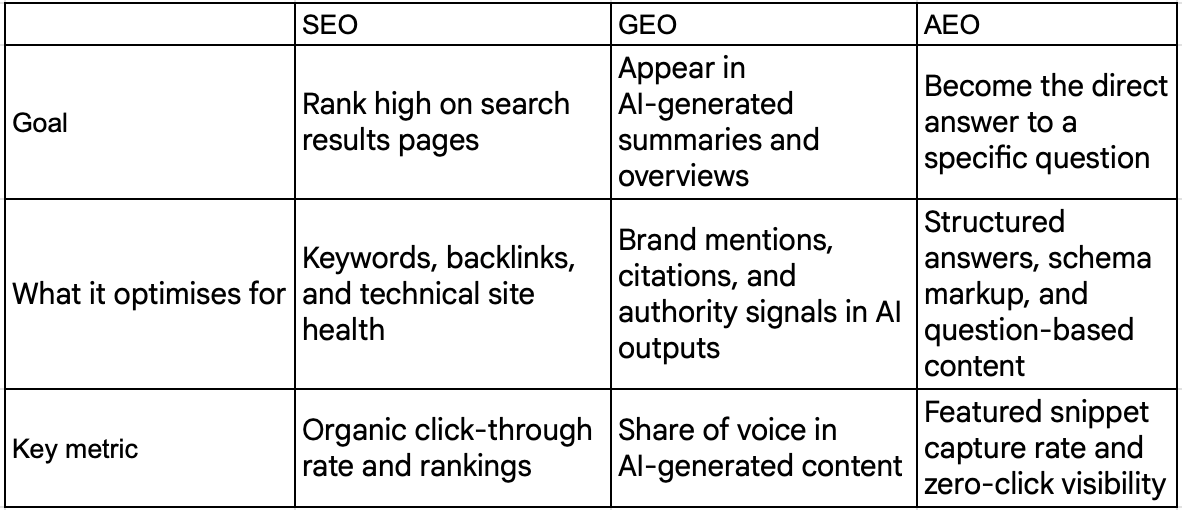
Think of SEO as winning a race to page one. GEO is about getting your brand mentioned in AI chats. AEO is about being the exact sentence an AI reads aloud to a user. All three matter. But India's fast-growing voice and mobile search landscape demands urgent action. AEO is becoming critical and time is running out.
Why Indian Marketers Must Act Now
India has over 700 million internet users. A huge share of searches is on mobile. Voice search in Hindi, Tamil, Telugu, Bengali, and other regional languages is exploding. When someone in Jaipur asks Siri in Hindi, "आज सोने का भाव क्या है?" - an answer engine responds instantly. No one clicks ten blue links anymore. Google's AI Overviews now appear on Indian SERPs for health, finance, education, and product queries. Brands that ignore AEO are invisible in this new layer. Act now. Most Indian brands are not optimising for answer engines yet. Those who move first will dominate AI-cited results for years.
The 5 Core AEO Signals (With India-Specific Examples)
1. Structured Content
Answer engines prefer content that is easy to parse. Short sentences help. Headers help. Bullet points help. Numbered lists help.Write in a question-and-answer format wherever possible. Start sections with the question your user is asking. Answer it in the first two sentences. Then expand.
India-specific example: A mutual fund platform like Groww can structure its blog posts to answer "What is an ELSS fund?" in the first two lines, then provide a detailed breakdown below. AI Overviews will pull that concise definition and cite Groww. Users see the brand even without clicking.Use questions as section titles to increase clarity. State user questions directly.
- State your key answer in the first 40-60 words of each section to improve action clarity.
- Avoid walls of text
- List steps for any process you describe. Make the process clear and sequential.
2. E-E-A-T: Experience, Expertise, Authoritativeness, and Trustworthiness
Google and AI tools do not quote just anyone. They quote credible sources. E-E-A-T is Google's framework for judging content quality. Experience means showing real-world knowledge. Expertise means demonstrating deep subject knowledge. Authoritativeness means earning recognition in your field. Trustworthiness means being accurate, transparent, and safe to recommend.
India-specific example: A health information portal like Practo builds E-E-A-T by listing authors with verified MBBS or MD credentials. Each article links to peer-reviewed studies. The "About the Author" section shows hospital affiliations and years of practice. AI tools recognise this authority. They cite Practo over un-credentialed health blogs. Create author bio pages with credentials and photos. Ensure each author is recognised and verified.
- Cite government sources like ICMR, RBI, or SEBI if relevant. Ensure reliable references.
- Link to your authors' LinkedIn profiles or published works
- Display your company registration or licence number on your site for transparency.
- Earn mentions and backlinks from respected Indian news outlets to build authority.
3. FAQ Schema Markup
Schema markup is a type of code you add to your page. It tells search engines exactly what type of content each section contains. The FAQ schema tells Google: "These are questions. These are the answers." This makes it far easier for AI to extract and display your content. You do not need to be a developer to add the FAQ schema. Many Indian website platforms including WordPress, Webflow, and Wix have plugins that add it automatically.
India-specific example: An insurance company like PolicyBazaar adds the FAQ schema to its term insurance landing page. Questions include "What is the maximum sum assured under term insurance?" and "Is term insurance premium tax deductible under Section 80C?" Google picks these up and displays them in rich results. When users ask the same questions via voice or text, PolicyBazaar's answers appear at the top.
- Add FAQ schema to each main product, service, and blog page. Confirm the schema is present.
- Write five to eight questions per page for clarity. Match the likely user search intent.
- Match questions to real search queries from Google Search Console
- Keep answers under 100 words to improve AI citation. Keep extraction straightforward.
- Validate your schema at schema.org/docs/gs.html
4. Entity Consistency
An "entity" is how AI systems understand who or what you are. Your brand name, location, founders, products, and industry are all entities. AI tools cross-reference these entities across the internet. If your NAP (Name, Address, Phone number) is different across your website, Google Business Profile, JustDial listing, and LinkedIn page, AI gets confused. It may not trust your brand. It may not cite you.Consistency is trust. Trust drives citation.
India-specific example: A D2C skincare brand like Mamaearth must ensure its brand name, headquarters (Gurugram), founder names (Varun and Ghazal Alagh), and product claims appear consistently across:
- Its own website and blog
- Wikipedia entry
- Press coverage in the Economic Times and the Mint
- Google Business Profile
- Amazon and Flipkart product listings
When AI tools see the same information repeated across multiple credible sources, they build a confident "entity profile" for Mamaearth. That confidence translates into citations.
What you should do:
- Audit all your brand mentions across directories, social platforms, and news sites.
- Fix inconsistencies in names, addresses, or phone numbers to improve trust and citation rates.
- Build a Wikipedia or Wikidata page for your brand. Make sure information is accurate.
- Claim and optimise your Google Business Profile fully
- Issue press releases through wire services to create consistent entity signals and boost credibility.
5. Content Freshness
AI tools prefer up-to-date information. Outdated content gets deprioritised. Search engines use "freshness" as a ranking signal, especially for time-sensitive queries. For Indian marketers, this is urgent. GST rates change. RBI policies shift. Festival dates vary every year. If your content is three years old, your brand is instantly invisible.Freshness does not mean publishing new articles every day. It means updating your key pages regularly and notifying search engines of those updates.
India-specific example: A fintech blog covering the "Current repo rate in India" must update its article whenever the RBI Monetary Policy Committee meets (roughly every two months). The article should display the "Last updated" date clearly at the top. It should reference the latest RBI press release. When someone asks ChatGPT or Perplexity about India's repo rate, the freshest and most credibly sourced article wins.
- Add a "Last Updated" date to every key page. Update this each time the content changes.
- Set a quarterly audit calendar for your top 20 pages. Schedule review dates in advance.
- Monitor seasonal and policy-driven queries in your niche. Identify which pages need regular updates.
- Republish updated versions of your best old posts. Clearly mark them as refreshed.
- Use Google Search Console to find pages losing traffic. Refresh those pages with updated information.
How to Start Your AEO Strategy This Week
You do not need a massive budget to begin. Start small. Start smart.
Day 1-2: Audit your top 10 landing pages. Identify the most common questions users ask about each. Rewrite the opening paragraph to answer one question directly.
Day 3-4: Install an FAQ schema plugin. Add at least five question-answer pairs to your homepage and your most-visited blog post.
Day 5-7: Check your entity consistency. Google your brand name. Look at your top five citations. Fix any mismatches in names, addresses, or descriptions.
Week 2 onward: Build a content freshness calendar. Identify your five most time-sensitive pages. Schedule quarterly updates for each. AEO is a long game, but the rewards go to those who move first. Early action gives you an edge that almost no other strategy can offer.
The India Opportunity Is Wide Open
Indian brands now have a first-mover advantage. Voice search in regional languages is growing. AI Overviews are expanding across Indian SERPs. Most brands are still using 2015-style SEO.You have the knowledge. You have the framework. Now act on it. The brands that answer best will win. Not the brands that rank highest or spend most on ads.The brands that structure their knowledge clearly, prove their authority, and stay fresh - those are the brands AI tools will quote. Those are the brands users will trust. That brand can be yours.
Frequently Asked Questions
Q1: Is AEO the same as optimising for Google's featured snippets?Featured snippets are one part of AEO. AEO is broader - it includes optimising for AI Overviews, voice search answers, Perplexity citations, and ChatGPT responses. Featured snippets are a good starting point, but you should think beyond just Google.
Q2: Do I need to stop doing SEO to focus on AEO?
No. AEO and SEO work well together. Strong SEO signals like backlinks, site speed, and keyword relevance also support AEO. Think of AEO as an additional layer on top of your existing SEO strategy.
Q3: How do I know if my content is being cited by AI tools?
Search your brand name and key topics on ChatGPT, Perplexity, and Google's AI Overviews. Check if your site appears as a source. Tools like Semrush and Ahrefs are also adding AI visibility tracking features you can use.
Q4: Does AEO work for regional language content in India?
Yes, and this is a major opportunity. Very few brands create structured, schema-marked content in Hindi, Tamil, Telugu, or Bengali. If your audience searches in a regional language, well-structured content in that language can dominate AI answers with far less competition.
Q5: How long does AEO take to show results?
You may see featured snippet gains within four to eight weeks of adding FAQ schema and restructuring key pages. AI Overview visibility can take longer, typically three to six months as AI tools build trust in your entity profile.
Q6: Is AEO relevant for small Indian businesses, or just large brands?AEO is especially powerful for small businesses. A local chartered accountant in Pune or a regional Ayurvedic brand in Kerala can dominate AI answers for hyper-local queries that big brands ignore. Local entity consistency and niche expertise matter more than domain authority here.
Featured Image: Google Gemini